The Truth Behind ‘Low Battery’ Status at Some EV Charging Stations This Raya

-full_normal.jpg)
You’ve seen the status on your app: “Station Battery Low.” You’ve felt the frustration: plugging into a 180kW-rated charger only to see it crawling at 20kW. This Raya, the Malaysian EV community has hit a literal wall, and it isn’t a grid failure. It’s a “Bucket and Tap” crisis that most people don’t even know exists.
The Inception of Charging: Charging the Charger
Most drivers assume that an EV charger is a direct "pipe" to the national grid. But at many of our busiest R&R stops, that simply isn't the case. Because our highway electrical infrastructure wasn't originally built for such massive, sudden power draws, operators like Gentari and JomCharge have deployed Battery Energy Storage Systems (BESS) at strategic locations to bridge the gap.
Think of it like a giant power bank. The station "trickles" energy from the grid into a massive on-site battery, which then "discharges" that energy quickly into your car.
The Raya Stress Test: When the Bucket Runs Dry
On a normal Tuesday, BESS works perfectly. But during the 2026 Raya rush, we’ve seen the technical limit. When car after car plugs in, the "bucket" (the BESS) empties faster than the "tap" (the grid) can refill it.

A charger with a 'Low Battery'? This irony is sparking a massive debate on Threads right now.
When you see that "Low Battery" status on the charger, the station isn't broken, it's exhausted. To protect its own battery health, the system throttles the speed. You aren't getting 180kW because the station literally doesn't have it to give.
Are ALL Stations Like This?
We need to distinguish between two types of hubs:
- BESS-Integrated Hubs: Typically found at highway lay-bys (like Behrang or Senawang) where the grid is weak. These are modular units that "store" power. They are brilliant for accessibility but have a "stamina" limit during festive seasons.
- Grid-Direct Hubs: Found in major city centers, newer industrial parks, and high-capacity petrol stations. These pull directly from a high-voltage TNB substation. If you want consistent, un-throttled speed during Raya, these are your best bet, even if it means exiting the highway for 10 minutes.
The Technical Proof: Why the Math Doesn’t Add Up
To understand why your charging speed is crawling, you have to look at the hardware hidden inside those modular containers. Most of the BESS units currently deployed at high-traffic spots like Behrang and Senawang are 300kWh units.
On paper, 300kWh sounds like a lot. But let’s do the math:
- A modern long-range EV (like an Ioniq 6 or BYD Seal) has a battery capacity of roughly 77kWh to 82kWh.
- If four of these cars show up back-to-back with 10% battery and want to charge to 80%, they will pull approximately 220kWh to 240kWh from that storage tank.
- The Result: By the time the 5th car plugs in, the "bucket" is effectively empty.
During a typical Raya rush where 10 to 15 cars might arrive per hour, the BESS is being drained 3x faster than the local grid can refill it. This is why the station hits "Low Battery" status, it’s not broken, it’s just physically out of juice and waiting for the "trickle" from the grid to catch up.
Quick Guide: BESS vs. Grid-Direct Hubs
-full_normal.jpg)
-full_normal.jpg)
How to Beat the "Empty Bucket" This Week


If you're heading back to the city after Raya", here is your technical survival guide:
- Check the App for Battery Icons: Apps like JomCharge and Gentari often show the station’s own SOC (State of Charge). If the station shows "Battery Low" status, keep driving.
- The 50% Rule: Don't wait for your car to hit 10% to look for a charger. If the highway BESS stations are throttled, you'll be stuck there for two hours. Charge early, charge often.
- Look for "Modular" Units: If the charger looks like a shipping container or a standalone box without a major substation nearby, it’s likely BESS-backed.

The Bottom Line: BESS is the only reason we have chargers in remote areas today, but Raya 2026 has proven that our "Power Banks" need a bigger refill.
Tech Decoded. Truth Unloaded. Only at CarzAutomedia | CariCarz.
Read: Top 10 CPOs In Malaysia
Written By
Sofea Najmi
A Bachelor of English Language and Literature graduate with an obsession for the finer details. Sofea uses her background in translation to decode the technicalities of automotive innovation. She is dedicated to delivering impactful, meticulously researched articles that provide a narrative far beyond the spec sheet. LinkedIn: https://bit.ly/3C018vv


JPJ Running Numbers
KUALA LUMPUR
VRS2271
SELANGOR
BSU1401
JOHOR
JF384J
PULAU PINANG
PSF9490
PERAK
APL8039
PAHANG
CFH8716
KEDAH
KGJ3035
NEGERI SEMBILAN
NEM1410
KOTA KINABALU
SJU3520
KUCHING
QAB6589P
Last updated 30 Sep, 2026
Fuel Price
Petrol
RON 95
RM 3.97
+1.38
RON 97
RM 4.90
+1.75
RON 100
RM 7.20
+2.20
VPR
RM 8.23
+2.00
Diesel
EURO 5 B10
RM 5.12
+2.08
EURO 5 B7
RM 5.32
+2.08
Last updated 30 Apr, 2026
Latest News

Kuching Gets Zeekr's First East Malaysia Store, With More Coming Next Year
Zeekr opens its first East Malaysia retail location at The Spring Kuching, with permanent sales and service centres targeted for Q1 2027.
29-09-2026
Buying A Hybrid Or EV? MAA Proposes Up To RM10,000 Tax Rebate
MAA proposes a RM7,000-RM10,000 income tax rebate for hybrid and EV buyers under Budget 2027, plus incentives for home charging and old-car scrapping.
28-09-2026
Driving Up North In An EV? There's A New 240 kW Charger At Rawang R&R
TNB Electron's new 240 kW DC EV charger at R&R Rawang Northbound is now live, with free charging available until 29 Sept 2026.
28-09-2026
Could An EV Really Work As A Malaysian Police Car? PDRM Is Finding Out
PDRM is testing the Proton e.MAS 5, e.MAS 7 EV and e.MAS 7 PHEV to see whether electrified vehicles could work for Malaysian police duties.
18-09-2026
Malaysia's Electricity Protection Is Now 800 kWh - How Much Power Does An EV Use Per 100 KM?
Malaysia's electricity protection threshold is now 800 kWh. Here's how much electricity popular EVs use per 100 km and what the extra 200 kWh means.
18-09-2026

17 New Mercedes Models Are Coming To Malaysia In 2027 - Here's What We Know
Mercedes-Benz Malaysia plans 17 new models for 2027, with most set for local assembly in Pekan. Here's what we know about its ICE and EV plans.
17-09-2026
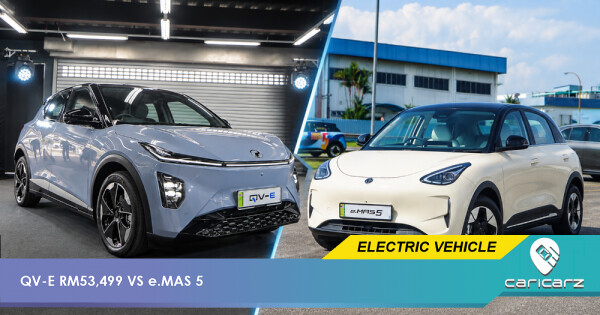
Perodua QV-E Now At RM53,499 Vs Proton e.MAS 5: Which Makes More Sense?
Perodua QV-E now starts at RM53,499 with BaaS under its Malaysia Day promo. See how it compares with the Proton e.MAS 5 on price, range, charging and features.
16-09-2026
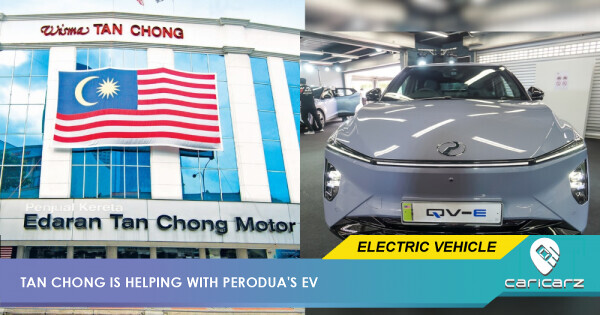
Yes, Tan Chong Is Involved In Perodua's EV. Here's What It's Actually Doing
Tan Chong has signed a three-year agreement to support Perodua's EV production with ED coating, painting and assembly-line services.
15-09-2026
Show More
trending_flat